

A technical comparison for ANSI/ESD S20.20-compliant worksurfaces to meet S4.1 standards for electronics assembly and S7.1 standards for datacenters.
A breakdown of our nitrile-butadiene rubber mat options briefly reviewing ESD grounding standards for tables, floors, people, and ESD Programs tailored to high-reliability (TR19) products.
Mat Thickness and Electrical Properties
All three Elimstat mat options use the same .08″ (2 mm) 5300 Series rubber, so the electrical characteristics are identical across them:
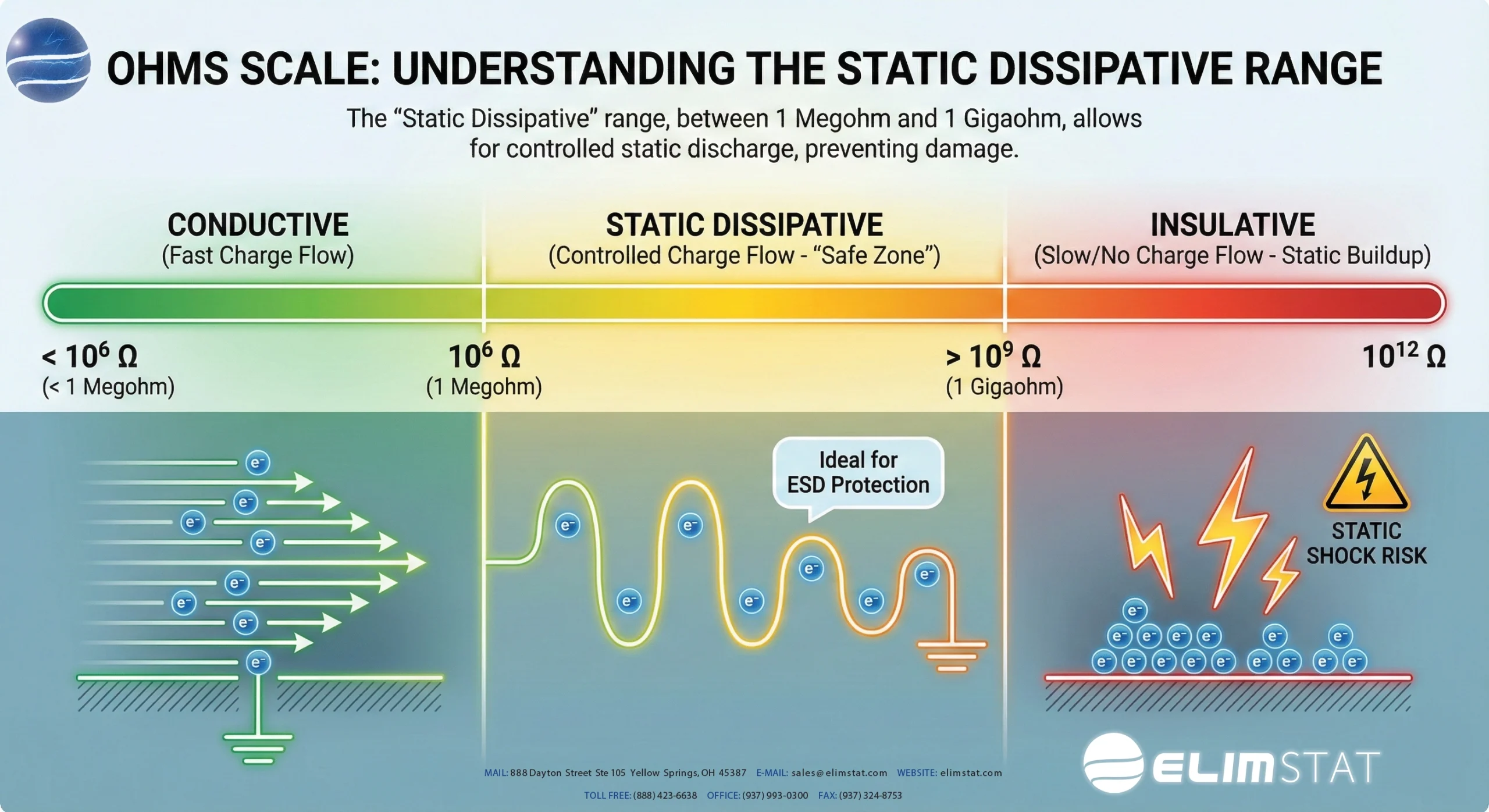
- Top layer (dissipative): surface resistance < 10⁹ ohms/square; tested point-to-point and resistance-to-groundable-point between 1 × 10⁶ and 1 × 10⁹ ohms to satisfy S4.1 §8.0.
- Bottom layer (conductive): surface resistance < 10⁵ ohms/square, volume resistivity < 10⁴ — this is the layer that carries charge to your ground path.
- Static decay: < 0.01 s; RoHS-compliant, lead-free, recyclable.
The carbon scrim is a highly engineered, consistent conductive grid. Because the current has only one viable option (straight down to the scrim), the thickness of the mat and the conductivity of the scrim is the largest variable for ESD resistance measurements outside of humidity control. This is why most ESD programs choose 2 layer mats versus 3 layer mats where the conductive layer would be sandwiched between two insulative layers which can exhibit wider ESD resistance ranges when exposed to humidity.
The three formats for ESD Mats
ESD mat rolls — bench coverage at scale
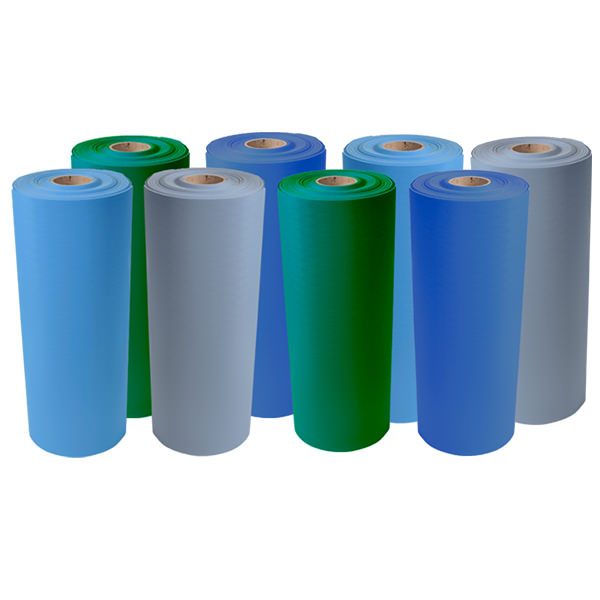
Rolls ship in 24″, 30″, 36″, and 48″ widths at 50′ lengths, priced from $443.78 to $887.54 (with a price break at 10+ units). This is the format for lining long benches, multiple stations, or an entire line where you want a continuous, seam-minimized dissipative surface and you’re willing to cut to fit.
The trade-off is install labor. You cut to length against a T-square, then install your own 4730 Series grounding snaps, supporting the mat from underneath so the prongs seat cleanly. For a facility standardizing dozens of stations, the per-square-foot cost and continuous coverage are an advantage to buying in rolls.
Rolls can also be used as floor runner, rack liner, and cart liner for setting up ESD Protected Areas (EPAs) that satsify ANSI / ESD S7.1. These are frequently chosen for setting up assembly areas where multiple surfaces need to be grounded.
Cut Mats — a die cut solution
The cut bench mats are the same 5300 Series rubber pre-sized to standard worksurface dimensions with grounding snaps already installed. You skip the cutting and the snap-seating step — the mat is ready to bond to a common point ground out of the box.
This is the right call when you have a fixed number of discrete workstations of known size, and the labor of cutting and snapping rolls isn’t justified.
Workstation Mat Kits — a straightforward ESD grounding solution
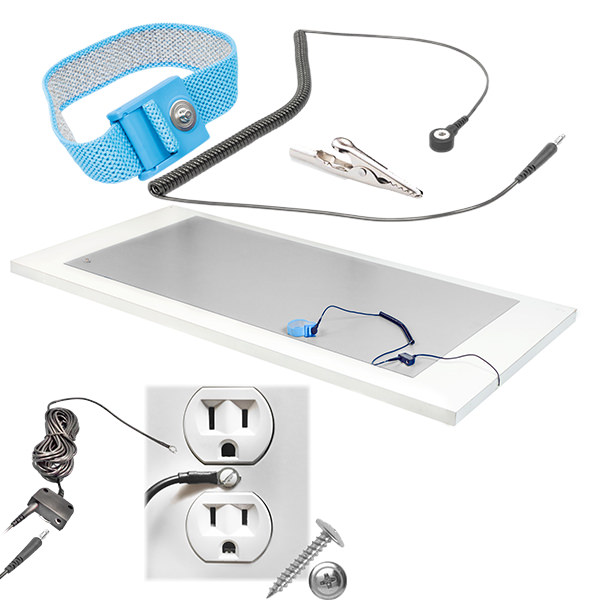
The kit is the turnkey option at $73.77 (1–9), $59.02 (10+) and bundles everything needed to stand up one compliant station:
- One 2′ × 4′ (600 × 1200 mm) 5300 Series mat with two snaps pre-installed on the long side.
- One 4715 Series common point ground with a 15′ ground cable terminating in a #10 ring terminal for direct screw-down into an outlet.
- One 240 Series wrist strap, 6′ coil cord, banana plug (optional alligator clip).
- Every cable and cord carries a built-in 1 megohm resistor.
For new station rollouts, the kit removes the BOM-assembly problem — there’s nothing to spec separately and nothing to mismatch.
Quick comparison
| Mat rolls | Cut bench mats | Workstation kit | |
|---|---|---|---|
| Material / spec | S4.1, S7.1 | S4.1 | S4.1, S6.1 |
| Sizing | 24–48″ × 50′ rolls, cut to fit | Pre-cut standard sizes | Fixed 2′ × 4′ |
| Snaps | Install yourself | Pre-installed (2) | Pre-installed (2) |
| Grounding included | No — source separately | No — source separately | Yes (Common Point Ground + Wrist Strap) |
| Cable cadence | Grounded Surface Per Cut Size | Per mat, Not daisy-chained | Per mat, Not daisy-chained |
| Best for | Benches, Carts, Floors, Racks | Fixed workstation sizes | Uniform Grounding |
| Indicative price | $443.78–$887.54 / roll | By size | $73.77 (1–9) / $59.02 (10+) |
ESD Grounding: How an ESD wrist strap fits
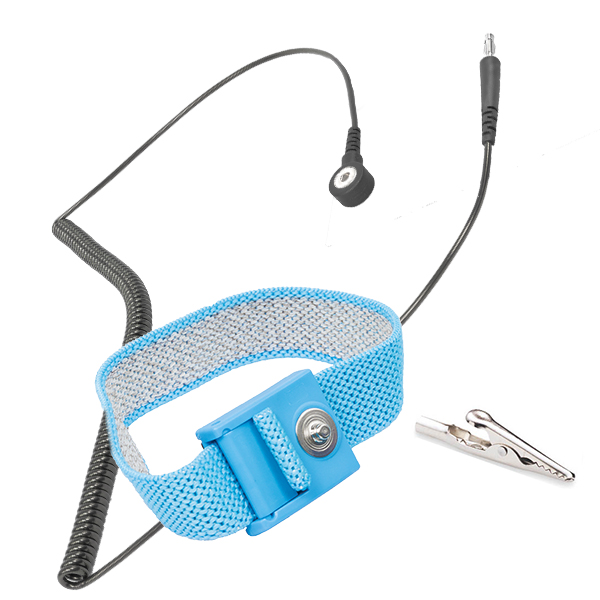
The wrist strap establishes a dedicated ground path from the skin’s surface to electrical ground: a 4 mm stud snap on the cuff connects to a coil cord with a built-in 1 megohm current-limiting resistor, which lands on a common point ground, which lands on the outlet via a ring eyelet. The outlet is generally the best ground reference in any building because it follows the equipment-grounding conductor back to earth.
One failure mode worth flagging to anyone wiring their own bench: do not clip the wrist strap to the mat as its ground path. Routing operator ground through the mat stacks the mat’s resistance on top of the cord’s 1 megohm and pushes total system resistance over the 35 megohm ceiling in the ESD Handbook TR20.20. The strap needs its own path to ground — through the common point ground — not a borrowed one through the worksurface. Reserve the alligator clip for cases where you’ve positively verified the path to ground; the screw-down eyelet is the safer default.
When to add a Continuous ESD Monitor
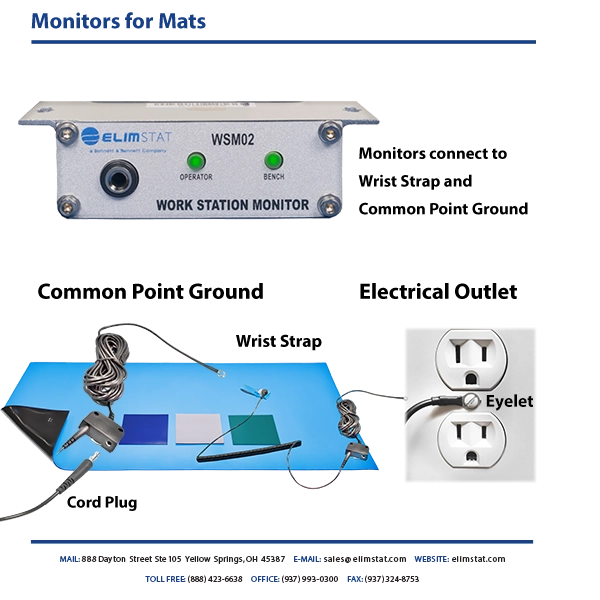
A wrist strap that has quietly failed open looks identical to one that’s working — until you find the damaged parts downstream. Daily strap testing is the baseline control, but it only proves ground at the moment of the test.
The continuous monitor (WSM02, $129.07) closes that gap. It uses capacitance sensing to watch one operator and one worksurface in real time, driving visual and audible alarms the instant the connection to the person or to ground fails. The standards give you explicit license to lean on it: ANSI/ESD S1.1 Annex A.3 allows daily wrist-strap testing to be omitted when constant monitoring is used, and ESD TR-19 §8.1 calls out continuous monitors for tracking the ground connection of high-reliability items in zero-defect EPAs (ESD Protected Areas).
The decision rule is essentially product value. If you’re producing parts where the cost of a single undetected ESD escape exceeds the monitor’s cost — high-reliability, zero-defect work — continuous monitoring is the proportionate control.
ANSI / ESD S20.20 Program
For most ESD Programs the path will be straightforward: cut mats or kits for fast, uniform workstations and rolls when you’re covering length and want continuous coverage at the best per-foot cost. Add continuous monitors when your ESD programs are tailored to high reliability or zero failure standards.