
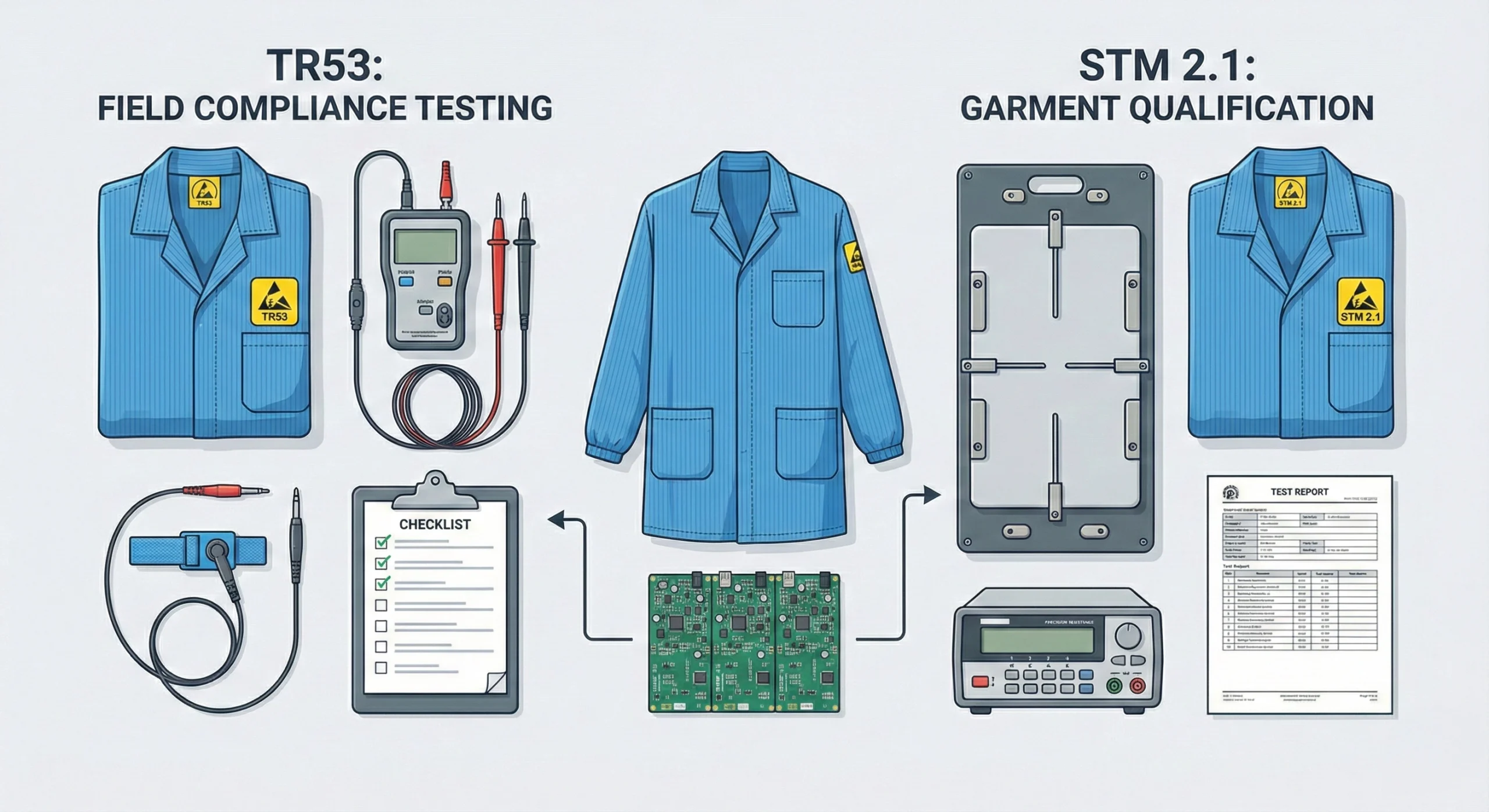
ESD Smock testing procedure requires the fabric to be measured as “static dissipative” on the Ohms scale and to be grounded (bonded electrically to a grounding system) so that it is not an isolated floating conductor. In this article, we review how ANSI / ESD S20.20-2021 defines ESD Smocks and explain the “isolated floating conductor” issue with wearing ESD clothing.
According to ANSI / ESD S20.20, ESD garments are either “Static Control Garments,” “Groundable Static Control Garments,” or “Groundable Static Control Garment Systems.” These definitions are evaluated using the static dissipative range and test procedures outlined in ESD STM2.1 for esd garment testing, and the grounding system requirements outlined in TR53, which include testing garments with wrist straps.
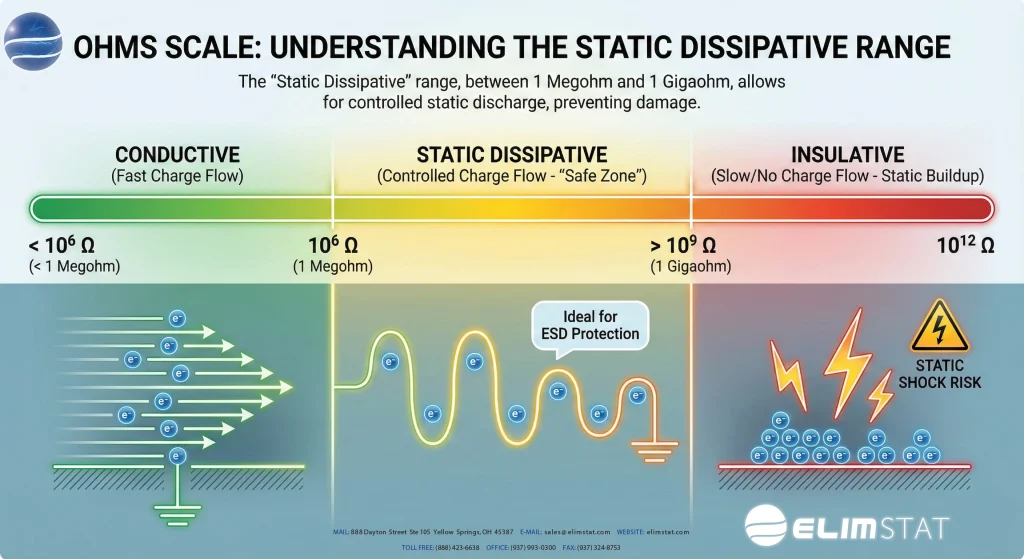
ESD Smock Requirements for ANSI / ESD S20.20
The minimum definition of an ESD smock is static shielding. This means the measured panel-to-panel conductivity is less than 1 x 10¹¹ ohms. A panel is a sewn section of a garment, such as the left arm, right arm, or torso.
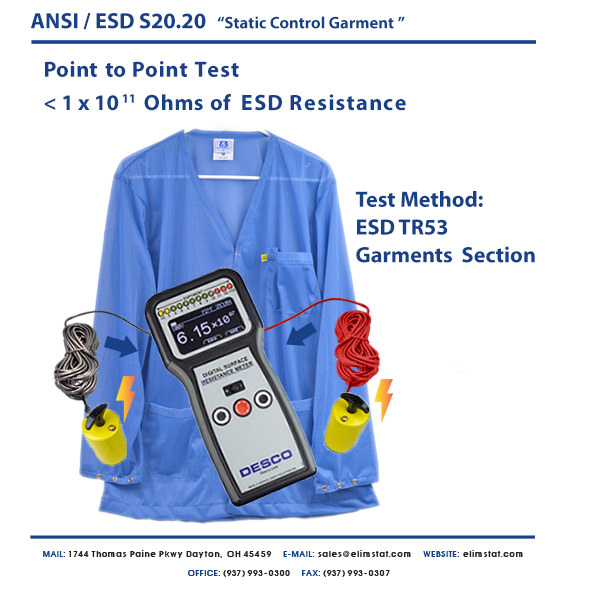
A “Static Control Garment” has a surface resistance of < 1 x 10^11 ohms measured point-to-point on the garment.
To perform this test, the garment should be electrically isolated (lying on an insulative surface). Then place the electrodes connected to the meter on the garment’s sleeve panels.
The meter will measure the lowest-resistance path between the electrodes on the sleeve panels.
This is sometimes also referred to as a “panel-to-panel conductivity” test. The reason is that it measures resistance across all the garment’s panels: sleeves, torso, etc.
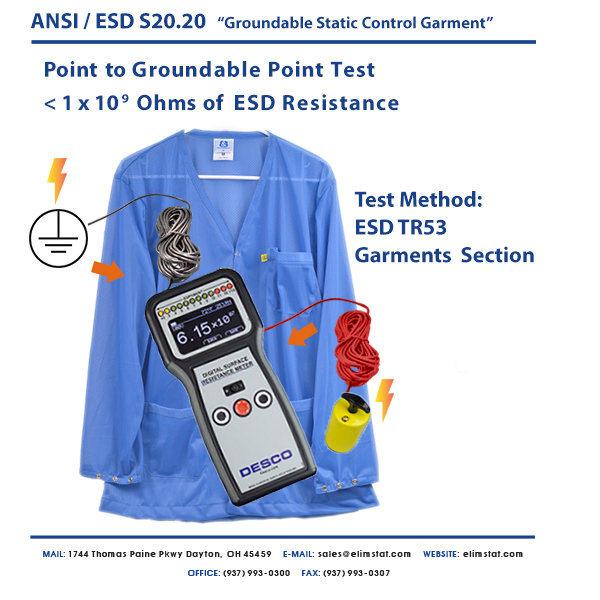
A “Groundable Static Control Garment” has < 1 x 10⁹ ohms surface resistance measured point-to-point and point-to-groundable point.
To perform the point-to-groundable point test, you will replace one of the electrodes that was on one of the sleeve panels with a ground.
The requirement of less than 1 x 10⁹ ohms (1 Gigaohm) of resistance is significant because it aligns with ANSI/ESD S4.1’s recommendation for workstation mats and TR53’s recommendation for shoe grounders.
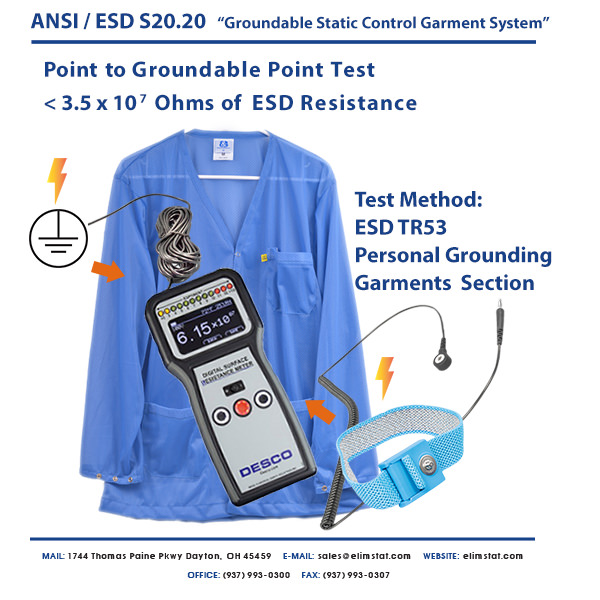
A “Groundable Static Control Garment System” has < 3.5 x 10⁷ ohms surface resistance measured point-to-groundable point with a person wearing it while connected by the wrist strap.
In ANSI / ESD S20-20 2007, this was mentioned in section “8.2 Personnel Grounding” in Note 2 from Table 2: “For situations where an ESD garment is used as part of the wrist strap grounding path, the total system resistance including the person, garment, and grounding cord shall be less than 3.5 x 10⁷ ohms.”
This is significant because it aligns
A groundable ESD smock is designed for use as personnel static control apparel within an ANSI/ESD S20.20–compliant ESD Control Program.
It should provide static shielding, controlled charge dissipation, and a groundable connection point for integration with an established personnel grounding system (e.g., a wrist strap or a footwear/floor system).
The smock itself is not a primary grounding device and is intended to function as a component within a larger ESD control system.
Isolated Floating Conductor Auditing
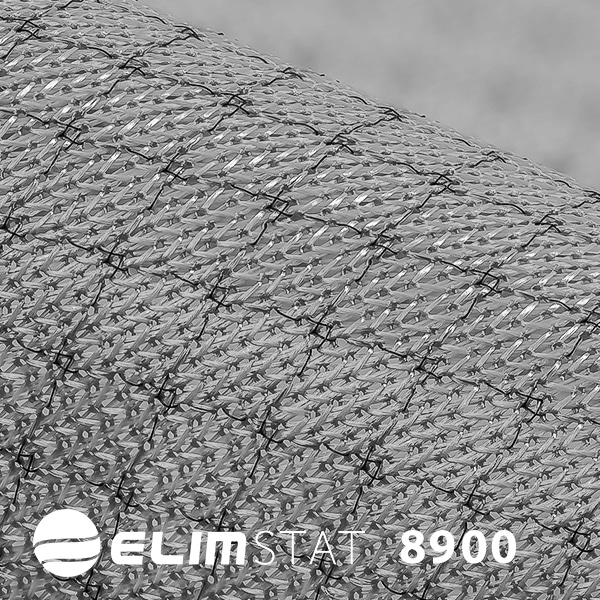
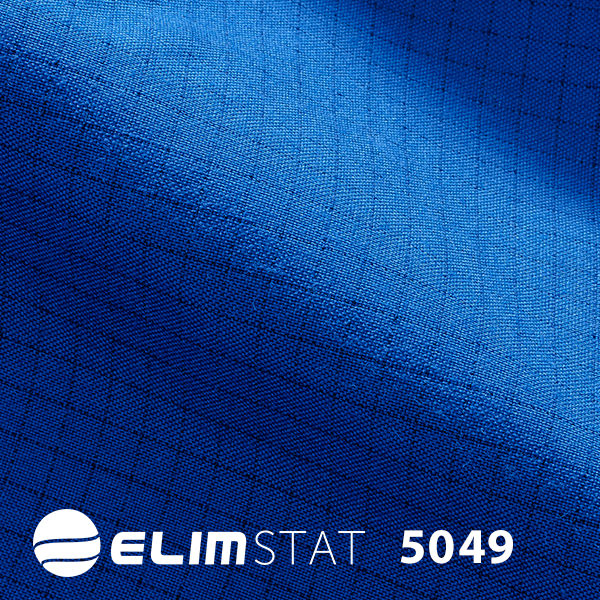
ESD smocks are precisely “groundable” because they are woven with conductive black carbon-based threading.
If an ESD Garment is not electrically bonded to mats, wrist straps, or floors that are grounded, it becomes a floating lightning rod- an “isolated floating conductor” essentially. The floating conductor issue is acknowledged by the ESD Association in TR20.20-20 section 5.3.13 ‘Garments’:
“After verifying that the garment has electrical conductivity through all panels, the garment should be electrically bonded to the grounding system of the wearer so as not to act as a floating conductor.”
As stated in the document:
“The single most important concept in the field of static control is grounding. Attaching all electrically conductive and dissipative items in the workplace to ground allows built-up electrostatic charges to equalize with ground potential. A grounded conductor cannot hold a static charge.”
A critical S20.20 principle:
Smocks are not primary personnel grounding devices
So:
- Wrist straps (or footwear/flooring) are always primary
- Smocks may:
- equalize potential
- shield fields
- reduce charge generation
- optionally provide a parallel ground path
TR53 reflects this by not requiring garments alone to meet personnel grounding limits.