
The short answer
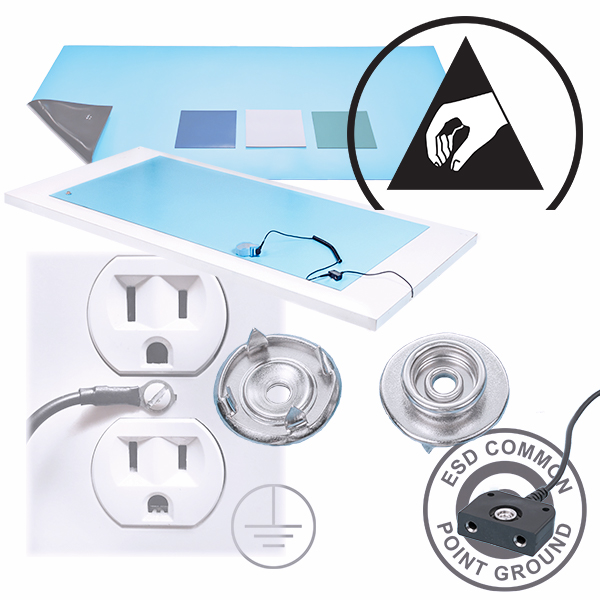
Ground an anti-static mat by laying it on a conductive bench, or by connecting a grounding cable from a snap on the mat to an electrical outlet. A floor mat uses the same cable when the floor is not a ground. Covering the table and the floor is how a workstation moves toward ANSI/ESD S6.1.
Where a mat sits on the resistance scale
- < 1×10^6 ΩConductiveBlack carbon bottom, and typical floor mats.
- 1×10^6 to < 1×10^12 ΩStatic dissipativeTop surface. Blue, gray, or green.
- > 1×10^12 ΩInsulativeCarpet, paint, glass, plastic, and wood. These isolate a mat from ground.
How to ground the mat
Place the table mat dissipative-side up
Cover the work surface with an anti-static mat. The blue, gray, or green dissipative side faces up. The black conductive side faces the bench.
Add a floor mat when the floor is ungrounded
Use an anti-static floor mat where people stand. These mats are typically black. A snap in the corner lets a grounding cable bypass the floor and send charge to an electrical outlet.
Snap the mat when an insulator isolates it
Carpet, floor paint, glass, plastic, and wood are insulators, above 1 × 10^12 ohms. Insert a conductive snap in the corner so the grounding cable has a dedicated path off the mat.
Connect a grounding cable to the outlet
Use a mat ground to ground the mat alone, or a common point ground to share that connection with a wrist strap. Cables made in the United States end in a #10 ring terminal that screws into a standard electrical outlet, and they include a 1 megohm resistor.
Add a continuous monitor when the work requires it
A continuous monitor is an alternative to relying on a mat ground alone. It applies a test voltage to the wrist strap and alarms, audibly and visually, when the mat or the wrist strap is not grounded.
Test top-to-top and top-to-ground
Use an ESD resistance meter and ESD Association STM 4.1-2017. Resistance top-to-top (RTT) checks that the top surface is static dissipative. Resistance top-to-ground (RTG) checks that the mat conducts to ground at a dissipative rate. For manufacturing, less than 1 × 10^9 ohms on an RTG test is generally the high end of what is suitable.
Three ways the mat reaches ground
Conductive bench or floor
No cable. Charge travels through the carbon layer into the bench or floor, then to ground.
Mat ground
A grounding cable grounds the mat separately from other surfaces.
Common point ground
One point grounds the mat and a wrist strap together.
US grounding cables end in a #10 ring terminal and include a 1 megohm (1 × 10^6 ohm) resistor.
Hardware used in this guide
Have you ever wondered how to ground an anti static mat or if all the ESD mats in your work area need to be grounded? Proper ESD mat installation is the most cost-effective way to eliminate static from any manufacturing, repair, storage, or testing area.
Types of Anti Static Mats
Anti Static Mats used for assembling or repairing electronics are placed over tables to dissipate static charges from those work surfaces.

Anti static mats are “grounded” by being placed on top of a conductive work surface or by using grounding cables to connect them to an electrical outlet.
The top surface is static dissipative. (The side that is blue, gray, or green.)
The bottom surface is conductive. Since it is impregnated with carbon, it is black.
A material is static dissipative if it offers between 1 x 10e6 and less than 1 x 10e12 ohms of resistance.
A material is conductive if it offers less than 1 x 10e6 ohms resistance.
To ground someone standing on an ungrounded floor, it is recommended to use anti static floor mats.

These mats are typically black because they are impregnated with carbon. Snaps on the corner of the mat allow you to bypass the floor, sending static directly from the mat to an electrical outlet using a grounding cable.
Once anti static mats are covering the table and floor, you are on your way to being in compliance with ANSI/ESD S6.1 (ESD Grounding Methods Requirements for Workstations).
Grounding Anti Static Mats

Since carbon is conductive, if the mat is laid on top of conducting tables and floors, static will travel through the mat, into the table, and dissipate at the floor into the ground.
Typically, you will want to connect an anti static mat for pc building to an electrical outlet.
Electrical outlets are normally the best ground for a mat in any building. This is because the wiring of outlets typically follows the piping of the building to the earth underneath the building.
Snaps for Anti Static Mats

A material is insulative if it has greater than 1 x 10e12 ohms of resistance.
Common insulators are carpets, floor paints, glass, plastics, and wood.
Insulating materials cause static to be created on work surfaces and contribute to electrostatic discharges (ESD) being created.
If an anti static mat is isolated from electrical ground by insulators (carpets, painted floors, or tables), you need to connect it to an electrical outlet by using a grounding cable.
To “ground” anti static mats, we insert a conductive snap on the corner of the anti static mat.
The snap is where you will connect the grounding cable. The conductivity of the snap will create a dedicated path for static to travel off the mat and into the cable.
Grounding Cables
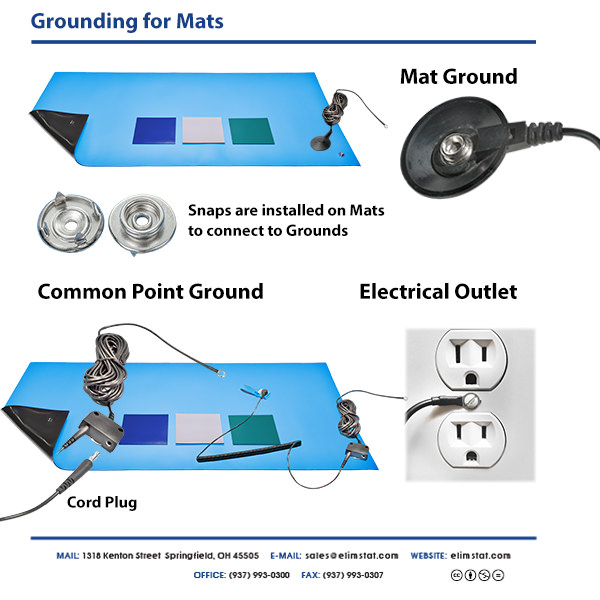
There are two primary types of grounding cables you can use to connect an anti static mat to an electrical outlet.
A mat ground is used to ground the mat separately from other surfaces.
A common point ground is used to ground the mat and a wrist strap at a common point.
Grounding cables made in the United States typically end in an “eyelet” – a #10 ring terminal– to screw directly into a standard US electrical outlet.
Grounding cables typically come with 1 meg ohm (1 x 10e6 ohms) resistors to ensure that electricity moving through them is always traveling at a static dissipative rate.
The purpose of the resistor is to slow down an electrostatic discharge event (ESD) from a highly charged ungrounded surface from discharging instantaneously through the cord. The resistor slows down ESD a few more milliseconds than if it were not present.
Continuous Monitors
“Typical Test programs recommend that wrist straps that are used daily should be tested daily. However, if the products that are being produced are of such value that knowledge of a continuous, reliable ground is needed, then continuous monitoring should be considered or even required.”
– ANSI / ESD TR20.20

A continuous monitor is an alternative to using mat grounds.
When a monitor is used it is to guarantee the ground connection of an anti static mat and a wrist strap.
They audibly and visually alert you when the mat or the wrist strap is not grounded.
It works by applying a continuous test voltage to the wrist strap and monitoring the distortions.
Testing Anti Static Mats
“The degree of protection afforded by a worksurface is strongly related to the time needed to discharge an object…. [R]esistance seems the best single predictor of performance of ESD-protective worksurfaces.”
– ANSI / ESD S4.1-2006
The standard used internationally to test anti static mats is ESD Association Standard Test Method (STM) 4.1- 2017 “Worksurfaces-Resistance Measurements”.
It recommends two tests – resistance measured top-to-top (RTT) and resistance measured top-to-ground (RTG).
The resistance top-to-top test measures whether or not the mat is static dissipative on its top surface.
The resistance top-to-ground test measures whether or not the mat is conducting to ground at a static dissipative rate.


< 1 x 10e9 ohms of resistance in an RTG test is generally considered the high end of what is suitable for an anti static mat that will be used for an activity like manufacturing.
To perform these tests, you would use an ESD Resistance Meter. The meter will charge voltage through the mat to measure its resistance.
Questions this guide answers
How do you ground an anti-static mat?
Lay it on a conductive work surface, or connect a grounding cable from a snap on the mat to an electrical outlet. Electrical outlets are normally the best ground in a building because their wiring follows the building piping to the earth.
Do you need a grounding cable if the bench is already conductive?
Not when the mat is in contact with a conductive bench or floor. Carbon in the mat lets charge travel into that surface and then to ground. If carpet, paint, glass, plastic, or wood isolates the mat, use a snap and a grounding cable.
Which side of an anti-static mat faces up?
The static-dissipative side faces up. It is blue, gray, or green. The conductive bottom is black because it is impregnated with carbon.
What is the difference between a mat ground and a common point ground?
A mat ground grounds the mat separately from other surfaces. A common point ground grounds the mat and a wrist strap at the same point.
Why does the grounding cable include a 1 megohm resistor?
The resistor keeps current at a static-dissipative rate, 1 × 10^6 ohms, so charge on an ungrounded surface does not discharge through the cord all at once. It slows the event by a few milliseconds.
What resistance is suitable for a mat used in manufacturing?
STM 4.1-2017 uses resistance top-to-top (RTT) and resistance top-to-ground (RTG). Less than 1 × 10^9 ohms on an RTG test is generally the high end of what is suitable for manufacturing. The meter charges voltage through the mat to measure that resistance.
When should a workstation use a continuous monitor?
ANSI/ESD TR20.20 says wrist straps used daily should be tested daily, and continuous monitoring should be considered or required when the product value calls for a continuous, reliable ground. The monitor alarms if the mat or the wrist strap is not grounded.